
About the Project
The Spitfire Project is an engineering project focused on improving the performance, reliability, and safety of a classic Triumph Spitfire through an iterative process of analysis, measurement, experimentation and design.
This website serves as an engineering notebook for the work, documenting measurements, design changes, test results, problems, and decisions throughout the build.
About the Car
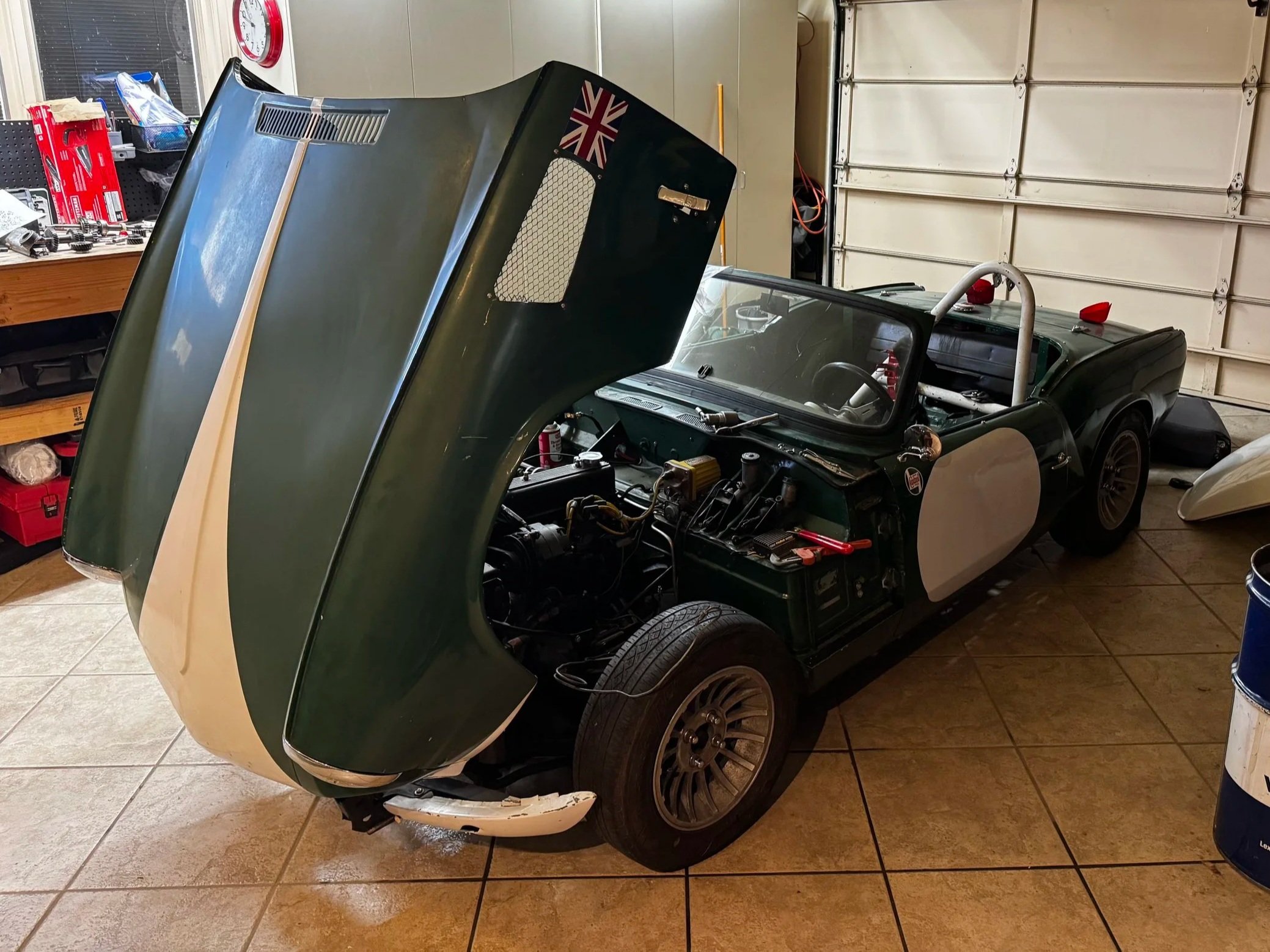
The Triumph Spitfire is a lightweight British roadster developed by Standard-Triumph as an affordable sports car. Built on a shortened Triumph Herald chassis and styled by Giovanni Michelotti, it used a simple body design, a separate-frame chassis, independent front suspension, and a front-hinged clamshell bonnet that made the engine bay easy to access. Across later models, Triumph updated the engine, gearbox, rear suspension, and braking systems while keeping the car light and mechanically simple. These traits made the Spitfire popular in SCCA racing and useful for modification, especially in areas like airflow, exhaust tuning, weight reduction, suspension setup, and drivetrain development.
-
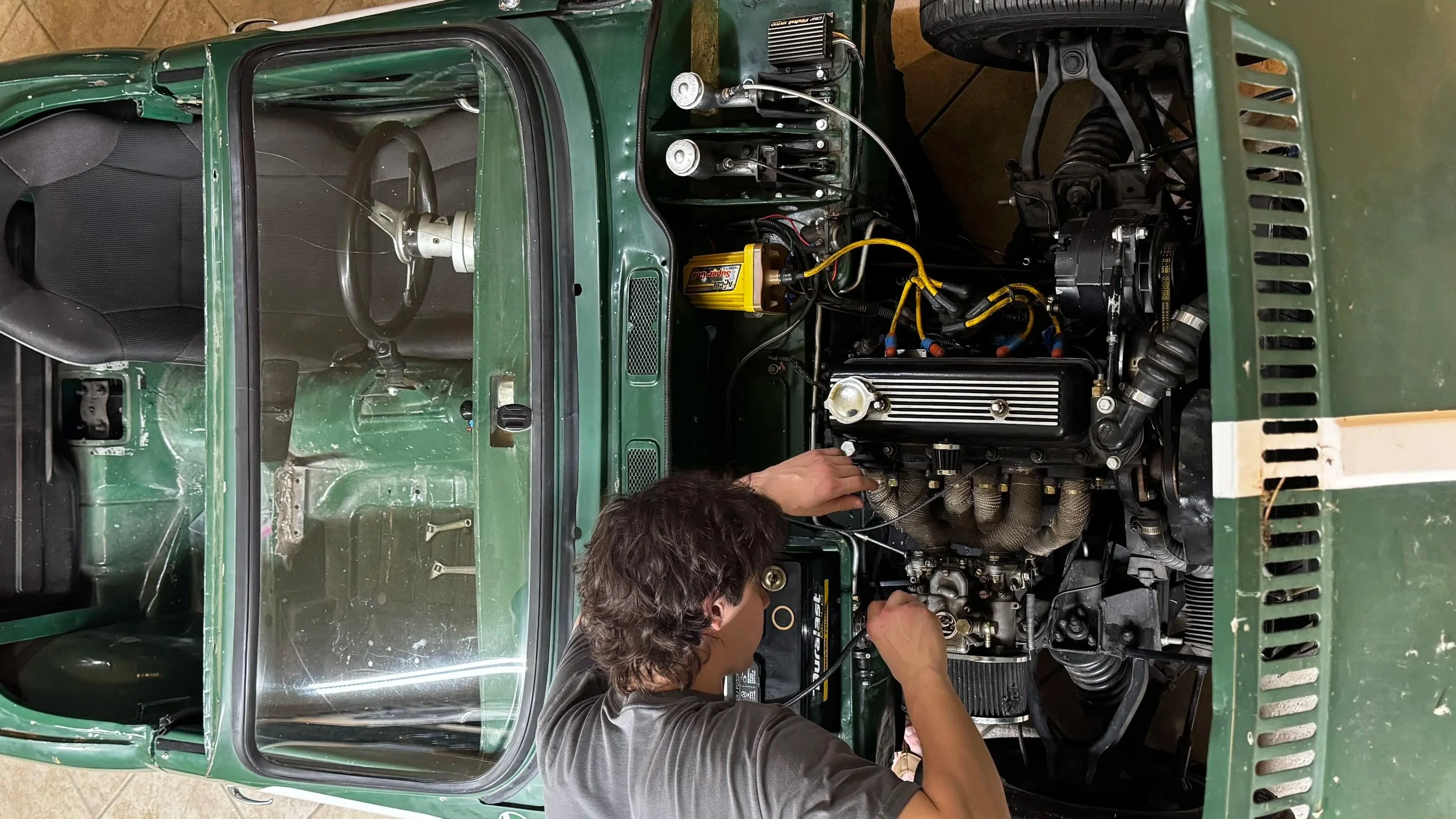
The 1147 cc inline-four is a compact, over square engine (approximately 69 mm bore × 76 mm stroke) tuned for higher-revving sports car duty. Constructed with a cast-iron block and head, it features a five-main-bearing crankshaft for durability, overhead valves actuated by pushrods, and was originally equipped with dual SU carburetors. Factory output was around 63 horsepower at roughly 5,750 rpm, with torque in the neighborhood of 67 lb-ft at about 3,500 rpm. While modest in absolute terms, the engine’s willingness to rev, simple mechanical layout, and strong bottom-end design made it highly adaptable to tuning. Upgrades such as increased compression ratio, improved cam profiles, ported cylinder heads, freer-flowing exhaust systems, and careful carburetor calibration could yield meaningful performance gains.
-
The engine is naturally aspirated and equipped with a Weber 40 DCOE sidedraft carburetor, an Italian-made performance classic. This single sidedraft design delivers precise fuel metering through twin throttle bores, boosting airflow and throttle response over the original SU carburetors. Its mechanical actuation and replaceable jets allow fine-tuning for optimal mixture and power, though it requires occasional adjustment. With a 40 mm venturi, it balances airflow and fuel atomization, enhancing efficiency and responsiveness. This setup preserves the car’s naturally aspirated character while offering increased performance and tuning flexibility, making it a key feature of the Spitfire’s induction and fuel system
-
The gearbox is a compact, four-speed manual transmission engineered for light weight and mechanical simplicity. Synchromesh is provided on second, third, and fourth gears (first gear is non-synchronized), using baulk-ring synchronizers to match shaft speeds during shifts. Each of three parallel selector rails inside the gearbox control a shift fork and gear pair, with interlock mechanisms to prevent simultaneous engagement of multiple gears. Power flows from the input shaft through a layshaft (countershaft) with constant-mesh helical gears, improving strength and reducing noise compared to straight-cut gears, while reverse uses a sliding idler gear. The architecture emphasizes serviceability and modularity—individual gearsets, needle bearings, and thrust washers can be inspected and replaced during rebuilds. Although not as refined as the later four-synchro unit introduced on subsequent Spitfire models, the 3-rail gearbox is mechanically robust, relatively light, and well suited to performance tuning when properly rebuilt with attention to end float, layshaft wear, and bearing condition
-
The suspension incorporates an independent double-wishbone layout with coil springs and lever-arm dampers upfront, providing precise camber control and relatively low unsprung mass for improved steering response. The rear employs a swing-axle independent suspension using a transverse leaf spring that also locates the differential and half-shafts. While compact and lightweight, the swing-axle geometry introduces significant camber change under load, which can increase oversteer at the limit—particularly during aggressive cornering. From an engineering standpoint, this makes rear ride height, spring rate, and camber control critical tuning variables. The simple body-on-frame construction allows straightforward modification of bushings, dampers, spring rates, and alignment settings. Careful suspension setup could dramatically improve balance and predictability.
-
The Spitfire uses a rack-and-pinion steering system, a relatively modern and performance-oriented choice for a small sports car of its era. The design consists of a simple mechanical rack driven by a pinion gear at the base of the steering column, translating rotational input directly into linear motion at the tie rods. This layout minimizes compliance (deflection under load) and lost motion compared to older steering box systems, resulting in precise steering feel and immediate feedback from the front tires. Steering effort is entirely manual, which increases low-speed effort but enhances road feel at speed. The short wheelbase, light front-end weight, and relatively quick steering ratio contribute to responsive turn-in and communicative handling. The system’s simplicity, low mass, and minimal number of moving parts make it both durable and easy to service, while careful attention to tie-rod ends, rack bushings, alignment, and steering column couplings is essential to maintain precision in performance applications.
-
In the racing configuration of my Spitfire, the instrumentation is arranged to provide continuous feedback on the engine’s most critical operating parameters, allowing detection of abnormal conditions before they lead to mechanical failure. Oil pressure and water temperature are monitored to verify that lubrication and cooling systems are functioning within safe limits, since loss of oil pressure or overheating can cause rapid engine damage under sustained high load. The voltmeter provides information on the health of the charging system and electrical supply, which is essential for ignition reliability at high engine speeds. A tachometer is used to monitor engine speed precisely, helping avoid over-revving and enabling consistent shift points. Fuel level and speedometer readings are secondary but still useful for managing fuel consumption, pacing, and diagnostics. From an engineering standpoint, this instrumentation transforms the car into a real-time monitoring system, allowing operating decisions to be based on measured data rather than solely on driver perception.